For a rare glimpse of Glenwood Landing and Glen Head's past, visit the Glenwood Fire Company Website. The description of the fire company’s founding in 1907 through its 90th anniversary, opens a compelling window on the area’s history.
You’ll learn about the Fyfe Shipyard, a major maritime center on Shore Road for nearly a century, the great fire at Wenlo, one of the region’s most stunning mansions (which firefighters saved and was recently placed on the national and state registers of historic places), and much more.
And, an added bonus, the Website is an excellent resource for fire safety information
Tuesday, April 25, 2006


Saturday, April 22, 2006
Civic Spot Adds Link to GW-GH Garbage District
Sometimes it seems easier to learn about what's happening on the other side of the planet than about what's happening down the block. That's why we recently were delighted to stumble across a weblog maintained by the Glenwood-Glen Head Garbage District and have added a link to the site from the Civic Spot.
All of the neighborhoods served by he Glenwood-Glen Head Garbage District are in the Town of Oyster Bay. That includes most of the Glenwood / Glen Head Civic Association's target area (the neighborhood between Kissam Lane and Scudders to the north and south, and Glen Cove Avenue and Shore Road to the east and west), except for the southwest portion of Glenwood Landing (which is in the Town of North Hempstead).
The district's weblog is handy for checking up on practical information that it's easy to forget, such as collection days, weight limits, and the fall leaf collection and holiday schedules. You can also read some interesting facts and figures that you'd be hard-pressed to find anywhere else, such as how and when the district was formed, the number of households in the district, and district boundaries.
We hope the district will continue to maintain the site and look forward to using it to learn more about important district-related matters—especially the budget, election, and names and terms of the commissioners.
All of the neighborhoods served by he Glenwood-Glen Head Garbage District are in the Town of Oyster Bay. That includes most of the Glenwood / Glen Head Civic Association's target area (the neighborhood between Kissam Lane and Scudders to the north and south, and Glen Cove Avenue and Shore Road to the east and west), except for the southwest portion of Glenwood Landing (which is in the Town of North Hempstead).
The district's weblog is handy for checking up on practical information that it's easy to forget, such as collection days, weight limits, and the fall leaf collection and holiday schedules. You can also read some interesting facts and figures that you'd be hard-pressed to find anywhere else, such as how and when the district was formed, the number of households in the district, and district boundaries.
We hope the district will continue to maintain the site and look forward to using it to learn more about important district-related matters—especially the budget, election, and names and terms of the commissioners.
Friday, April 21, 2006
Protecting Environmental Bond Recommendations
The Nassau County Planning Commission is reviewing the Environmental Bond Act recommendations made by the Environmental Program Advisory Committee on March 6. County legislators will vote on the recommendations sometime in May. If approved, the projects will be funded by the $50 million environmental bond referendum voters passed in 2004 by a margin of more than 4 to 1.
The Glenwood / Glen Head Civic Association urges the Planning Commission and the Nassau County Legislature to accept the Advisory Committee’s recommendations without alteration. We believe the application and review process was painstaking, fair and objective. We believe that altering the recommendations made by the committee would undermine public confidence in the legislature and in the environmental program that voters intended to support.
The Advisory Committee received 262 proposals and recommended 57 projects. All of these projects represent valuable improvements that will benefit everyone who lives, works, or plays in Nassau County. The list includes 15 parcels for open space acquisition, improvements at 18 parks, 17 stormwater improvement projects, and 7 brownfield clean-up projects.
One of the parcels recommended for open space acquisition is on the Glenwood Landing Waterfront; five others are in the immediate vicinity of Hempstead Harbor (see "GWL Waterfront Scores as County Priority," March 10). The remaining 51 projects are well dispersed throughout the county, from east to west and north to south. The civic association supports each and every one of these recommendations with full confidence in the criteria that the Advisory Committee established to evaluate the applications and in the judgments the Advisory Committee made based on these criteria.
Please consider contacting county legislators and the Planning Commission to express your views on this matter (see below). A press release titled Suozzi Advisory Committee Announces Proposed Uses for $50 Million Environmental Bond and the Environmental Program Advisory Committee Report are posted on the Nassau County Website.
The public servants below can be reached at 1 West Street, Mineola, NY 11501; legislators can be emailed directly from the Legislator Page of the Nassau County Website.
Patricia Bourne, Director, Nassau County Planning Commission (516-571-5847)
Lewis Yevoli, Chairman, Nassau County Planning Commission (516-571-5844)
Legislator Craig Johnson, LD 11, including Glenwood Landing (516-571-6211)
Legislator Diane Yatauro, LD 18, including Glen Head (516-571-6218)
Legislator Peter J. Schmitt, Minority Leader (516-571-6212)
Legislator Judith Jacobs, Presiding Officer (516-571-6216)
The Glenwood / Glen Head Civic Association urges the Planning Commission and the Nassau County Legislature to accept the Advisory Committee’s recommendations without alteration. We believe the application and review process was painstaking, fair and objective. We believe that altering the recommendations made by the committee would undermine public confidence in the legislature and in the environmental program that voters intended to support.
The Advisory Committee received 262 proposals and recommended 57 projects. All of these projects represent valuable improvements that will benefit everyone who lives, works, or plays in Nassau County. The list includes 15 parcels for open space acquisition, improvements at 18 parks, 17 stormwater improvement projects, and 7 brownfield clean-up projects.
One of the parcels recommended for open space acquisition is on the Glenwood Landing Waterfront; five others are in the immediate vicinity of Hempstead Harbor (see "GWL Waterfront Scores as County Priority," March 10). The remaining 51 projects are well dispersed throughout the county, from east to west and north to south. The civic association supports each and every one of these recommendations with full confidence in the criteria that the Advisory Committee established to evaluate the applications and in the judgments the Advisory Committee made based on these criteria.
Please consider contacting county legislators and the Planning Commission to express your views on this matter (see below). A press release titled Suozzi Advisory Committee Announces Proposed Uses for $50 Million Environmental Bond and the Environmental Program Advisory Committee Report are posted on the Nassau County Website.
The public servants below can be reached at 1 West Street, Mineola, NY 11501; legislators can be emailed directly from the Legislator Page of the Nassau County Website.
Patricia Bourne, Director, Nassau County Planning Commission (516-571-5847)
Lewis Yevoli, Chairman, Nassau County Planning Commission (516-571-5844)
Legislator Craig Johnson, LD 11, including Glenwood Landing (516-571-6211)
Legislator Diane Yatauro, LD 18, including Glen Head (516-571-6218)
Legislator Peter J. Schmitt, Minority Leader (516-571-6212)
Legislator Judith Jacobs, Presiding Officer (516-571-6216)
Thursday, April 20, 2006
Buildings Secured at Proposed Subdivision
Unoccupied buildings on the northwest corner of Glenwood Road and Kissam Lane, where a subdivision of seven single-family homes is planned, have been secured. The buildings have been open to the weather since at least last fall. Earlier this month, and on several previous occasions, the Glenwood / Glen Head Civic Association has requested that the Town of Oyster Bay (TOB) require the buildings to be properly sealed until such time as they may be demolished to make way for new construction (see Better Maintenance Needed at Glenwood Landing Subdivision, April 8).
We await word from the Nassau County Planning Commission about the status of site plan review for two lots at the front of the property created by a zoning change granted by TOB; protection of the Native American artifacts documented at the site; and seismic studies being required because of the scale of the retaining walls that will be needed to accommodate the extensive amount of soil that would be removed to create seven building lots.
The existing buildings have stood on the site since the 19th century. They were originally owned by the Townsends, one of Glenwood Landing's earliest families. The civic association commissioned a historical study of the site and submitted it to the TOB Landmarks Commission with the hope that it would be possible to preserve the structures. Unfortunately, no mechanism was found.
The civic association has participated in review of the subdivsion and proposed several alternatives, including a cluster plan and a five-structure/six-unit plan.
We await word from the Nassau County Planning Commission about the status of site plan review for two lots at the front of the property created by a zoning change granted by TOB; protection of the Native American artifacts documented at the site; and seismic studies being required because of the scale of the retaining walls that will be needed to accommodate the extensive amount of soil that would be removed to create seven building lots.
The existing buildings have stood on the site since the 19th century. They were originally owned by the Townsends, one of Glenwood Landing's earliest families. The civic association commissioned a historical study of the site and submitted it to the TOB Landmarks Commission with the hope that it would be possible to preserve the structures. Unfortunately, no mechanism was found.
The civic association has participated in review of the subdivsion and proposed several alternatives, including a cluster plan and a five-structure/six-unit plan.
Living with Geese
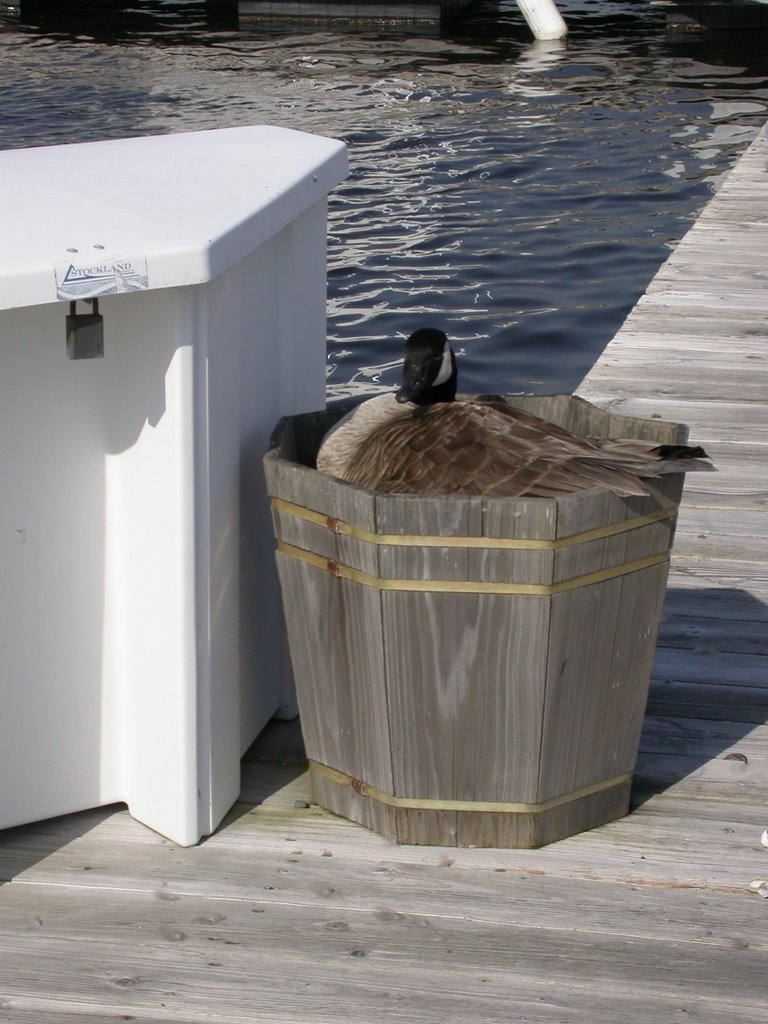
It’s spring, and that means teams of specially trained municipal workers and volunteers are tramping around wetlands, golf courses, sumps, land fills, and even shopping malls armed with umbrellas, buckets, and vegetable oil. The teams are searching for geese that are nesting in areas that interfere with human activity and that are unsafe for the birds.
Like the goose at left, which is incubating her eggs in a planter on a dock, geese are increasingtly nesting in inappropriate places throughout Long Island and the entire eastern seaboard.
Each time a nest with at least one goose egg is located, the umbrella is used to shoo away the parents. The bucket is filled with water, and the egg is placed in the bucket. If the egg sinks, the embryo has not started to develop. In such cases, the egg is oiled to prevent oxygen diffusion. Cutting off the oxygen supply prevents the development of the embryo. Thus, a chick will not hatch. The egg is then placed back in nest so that the parents will not lay another egg to replace it—and population growth is reduced by one.
Eggs found in nests located in good nesting habitats also are oiled in order to limit popultaion growth as much as possible.
The effort is part of GeesePeace, a humane geese control program adopted by the Town of Oyster Bay, the Town of North Hempstead, and some villages. The program also involves site aversion. After the chicks hatch and before the birds molt (lose their feathers and are temporarily unable to fly), specially trained dogs (usually border collies) are used to systematically heard the birds away from inappropriate locations.
What you can do
It is important not to feed geese. Feeding geese is bad for the birds. Grasses and other plants are the natural diet of geese. A diet of bread and other human foods causes vitamin deficiency and makes geese vulnerable to serious, debilitating avian diseases. Feeding geese also encourages the geese to remain in an area and attracts more geese to the vicinity. This undermines the humane goose control management policies of local municipalities.
How geese affect water quality
For thousands of years, flocks of Canada geese have migrated across Long Island twice a year, in the Fall en-route to southern wintering grounds and in the Spring en-route to northern nesting grounds.
But, in recent years, flocks of resident, non-migratory Canada geese have grown so large that they have become a serious nuisance, a health threat, and a source of pollution. Runoff from geese waste drains into streams and storm drains and enters waterways, where it contributes to pollution. Geese waste also causes problems on golf courses, playgrounds, and ball fields.
The geese causing these problems were introduced to Long Island and neighboring states several decades ago for hunting and conservation purposes. The swelling population of these non-migratory geese—and the problems associated with them—were not anticipated.
Wonder birds
Geese are intelligent, excellent parents. They stay together all year and mate for life but will find a new partner if a mate dies. Migratory geese mate and nest in Canada. Only resident geese that were born in the United States mate and nest in the United States.
Migration is a learned process. Migratory geese return to the general area of their birth each year to mate and nest. Sometimes they nest in the exact same location from year to year, sometimes they choose a location nearby. Migratory geese do not become resident geese unless they are injured.
The flight range of migratory geese is 2,000- to- 3,000 miles. In contrast, resident geese fly 100- to- 200 miles to find food, water, and safety. Resident geese could fly as long a distance as their migratory cousins, but they have learned that long flights are not necessary.
Nesting
Nesting season is from mid-March to mid-May. Geese begin to nest at age three. They prefer isolated sites near water. Islands are their favorite location. Nests are usually on the ground. When egg laying begins the male partner, known as the sentinel goose, stands watch nearby—but not close enough to give away the location of the nest to a predator. When a solitary goose is seen during nesting season, it’s probably the sentinel goose—and a nest probably is somewhere in the vicinity.
The group of eggs laid by the female is called a clutch. She generally lays 1 egg every 24 hours for several days until a full clutch is established (5 eggs on average). When all the eggs are laid, she begins to incubate them. Thus, all the hatchlings are the same age when the hatch. The incubation period is 28- to- 30 days.
It is easy to tell if the embryos have started to develop. Eggs not being incubated are cool to the touch. Undeveloped eggs that are still fluid sink or float vertically with the wider portion of the egg pointing down. Developing eggs float horizontally or at a slight angle and break the surface of the water.
At that point the goslings are 1- to- 2 weeks away from hatching.
All geese eggs in a single clutch hatch on approximately the same day. Baby geese are called goslings. They can fly approximately 2- to- 3 months after hatching. Geese can live up to 20 years and usually weight 20- to- 30 pounds.
When geese are chased from a traditional nesting area or a nesting area with too many nesting pairs, they find alternative sites to nest. These sites are often quite marginal—too far away from water and food—and may be in highly inappropriate locations—such as rooftops, balconies, ball fields, golf courses, and parks.
Molting
Each June, adult geese lose their wing feathers, a process called molting, and are temporarily unable to fly. Molting season runs from early June to late July. During the molt, geese need to be near water for easy escape from predators, and a food supply must be accessible. Foxes, raccoons, owls and snapping turtles are the natural predators of geese. Geese can fly again approximately 6 weeks after molting. Generally, by early August all geese (except those that are injured) are ready for flight.
Photo by Jennifer Wilson-Pines
GeesePeace Coordinator
Saturday, April 08, 2006
Adopt a Tree on Glenwood Road
Last Sunday afternoon, the 23 saplings planted along Glenwood Road in December received their first major drink of spring—four liters of water for each delivered by members of the Glenwood / Glen Head Civic Association. Nature followed up today with a welcome 1.7 inches of rainfall.
The trees were planted by the Nassau County Dept. of Public Works to replace older trees that have been lost over the last several years (see On Your Mark, Get Ready, Start Watering, March 26; New Trees for Glenwood Road, March 16).
If there’s a tree in the vicinity of your home, don’t forget to help get it off to a good start by giving it a minimum of one slow, soil-soaking drink a week throughout the spring and summer (more if there is a dry spell). Civic Association waterers were able to skip watering two trees that had already been watered by nearby neighbors.
According to the county, nearly all of the trees planted are sidewalk- and wire-friendly. In two instances taller trees with deeper root systems were planted in locations with no sidewalks; these trees are also relatively easy to prune because they have no central leader.
The sidewalk- and wire-friendly trees are Japanese Tree Lilacs and Japanese Kwanzan Cherries. The county tells us that if you live at 13, 26, 28, 29, 34, 36, 49, 59, or 72 Glenwood Road, you received a Japanese Tree Lilac; if you live at 65, 77, 86, 91, 98 101A, 108, 109, or 112 Glenwood Road, you received a Japanese Kwanzan Cherry; if you live at 126 or 128 Glenwood Road, you received a stately Japanese Zelkova. In a few instances, two trees were planted in front of one property.
Have you watered your tree yet? Are you considering doing so? Consider posting a comment to let the civic association—as well as visitors to the site—know. If you cannot reach the tree with your hose or if you do not have a watering can, you can fill up a couple of empty soda or milk bottles. Civic association waterers used two-liter soda bottles last week. Have a better technique? Why not let us know?
The trees were planted by the Nassau County Dept. of Public Works to replace older trees that have been lost over the last several years (see On Your Mark, Get Ready, Start Watering, March 26; New Trees for Glenwood Road, March 16).
If there’s a tree in the vicinity of your home, don’t forget to help get it off to a good start by giving it a minimum of one slow, soil-soaking drink a week throughout the spring and summer (more if there is a dry spell). Civic Association waterers were able to skip watering two trees that had already been watered by nearby neighbors.
According to the county, nearly all of the trees planted are sidewalk- and wire-friendly. In two instances taller trees with deeper root systems were planted in locations with no sidewalks; these trees are also relatively easy to prune because they have no central leader.
The sidewalk- and wire-friendly trees are Japanese Tree Lilacs and Japanese Kwanzan Cherries. The county tells us that if you live at 13, 26, 28, 29, 34, 36, 49, 59, or 72 Glenwood Road, you received a Japanese Tree Lilac; if you live at 65, 77, 86, 91, 98 101A, 108, 109, or 112 Glenwood Road, you received a Japanese Kwanzan Cherry; if you live at 126 or 128 Glenwood Road, you received a stately Japanese Zelkova. In a few instances, two trees were planted in front of one property.
Have you watered your tree yet? Are you considering doing so? Consider posting a comment to let the civic association—as well as visitors to the site—know. If you cannot reach the tree with your hose or if you do not have a watering can, you can fill up a couple of empty soda or milk bottles. Civic association waterers used two-liter soda bottles last week. Have a better technique? Why not let us know?
Better Maintenance Needed at Glenwood Landing Subdivision
Concern about the condition of the property at the northwest corner of Glenwood Road and Kissam Lane opposite the Glenwood Landing Post Office has prompted the Glenwood / Glen Head Civic Association to contact the Nassau County Planning Commission and the Town of Oyster Bay about improved maintenance and proper development of the site.
A seven-unit subdivision is planned for the site. In the interim between subdivision approval and groundbreaking, the property has fallen into disrepair. Existing buildings are open to the weather, the grounds are poorly maintained, and debris frequently collects along the sidewalk and at other locations.
Last year, the Oyster Bay Town Board approved a zoning change from commercial to residential that created two of the seven lots. The civic association has contacted the town on several occasions since the zoning hearing to request that the town require the property to be maintained in a manner consistent with the town code: specifically that existing buildings be secured until such time as they may be demolished and that the grounds be properly maintained.
Unfortunately, the buildings remain open to the weather, as they have been for more than a year, and the build up of yard debris is common.
The Nassau County Planning Commission has approved a site plan for the additional five lots in an existing residential zone, with certain conditions. Among these conditions are that:
• the two lots created by the zoning change be presented to the county planning commission for site plan review;
• the Native American artifacts documented at the site be protected before any demolition or construction occurs;
• seismic studies be conducted because of the scale of the retaining walls that will be required to accommodate the extensive amount of soil that would be removed to create seven building lots.
The civic association has contacted the county planning commission to request a hearing to determine if the Native American artifacts have been properly removed and, therefore, that they no longer impede any application a developer might make to the town for a demolition permit.
The civic association also has requested that the county provide information about when in the development process the seismic studies would be conducted and how the results will be documented and presented to the public.
The civic association has participated in the review of this subdivision for at least six years. Among its proposals was a five-unit residential plan with four single-family structures and one owner-occupied two-family structure; we also urged the involved parties to consider a cluster plan. Shortly before the zoning hearing, stakeholders in the Glenwood Landing Business District requested that the Town Board maintain the commercial status of the property; the civic association was pleased to support this request.
Prior to the zoning change, the civic association commissioned a study of the property that was submitted to the Town of Oyster Bay Landmarks Commission. The study documented continuous human occupancy of the site from the pre-colonial period through the present and noted the importance of the Native American artifacts at the site. The study also noted that the Townsends, a local family with historic significance, were the original owners of the property and that the family retained ownership from the pre-revolutionary period through the early part of the last century. There have been only three owners of the site since the Townsend’s relinquished title. Our historian estimated that at least one structure on the site dates to the1850s, although a site inspection was not permitted by the owner of the property at the time the study was conducted.
The Landmarks Commission concluded that the documentation submitted by the civic association did not indicate that the property merited further investigation and rejected landmark status for the property.
A seven-unit subdivision is planned for the site. In the interim between subdivision approval and groundbreaking, the property has fallen into disrepair. Existing buildings are open to the weather, the grounds are poorly maintained, and debris frequently collects along the sidewalk and at other locations.
Last year, the Oyster Bay Town Board approved a zoning change from commercial to residential that created two of the seven lots. The civic association has contacted the town on several occasions since the zoning hearing to request that the town require the property to be maintained in a manner consistent with the town code: specifically that existing buildings be secured until such time as they may be demolished and that the grounds be properly maintained.
Unfortunately, the buildings remain open to the weather, as they have been for more than a year, and the build up of yard debris is common.
The Nassau County Planning Commission has approved a site plan for the additional five lots in an existing residential zone, with certain conditions. Among these conditions are that:
• the two lots created by the zoning change be presented to the county planning commission for site plan review;
• the Native American artifacts documented at the site be protected before any demolition or construction occurs;
• seismic studies be conducted because of the scale of the retaining walls that will be required to accommodate the extensive amount of soil that would be removed to create seven building lots.
The civic association has contacted the county planning commission to request a hearing to determine if the Native American artifacts have been properly removed and, therefore, that they no longer impede any application a developer might make to the town for a demolition permit.
The civic association also has requested that the county provide information about when in the development process the seismic studies would be conducted and how the results will be documented and presented to the public.
The civic association has participated in the review of this subdivision for at least six years. Among its proposals was a five-unit residential plan with four single-family structures and one owner-occupied two-family structure; we also urged the involved parties to consider a cluster plan. Shortly before the zoning hearing, stakeholders in the Glenwood Landing Business District requested that the Town Board maintain the commercial status of the property; the civic association was pleased to support this request.
Prior to the zoning change, the civic association commissioned a study of the property that was submitted to the Town of Oyster Bay Landmarks Commission. The study documented continuous human occupancy of the site from the pre-colonial period through the present and noted the importance of the Native American artifacts at the site. The study also noted that the Townsends, a local family with historic significance, were the original owners of the property and that the family retained ownership from the pre-revolutionary period through the early part of the last century. There have been only three owners of the site since the Townsend’s relinquished title. Our historian estimated that at least one structure on the site dates to the1850s, although a site inspection was not permitted by the owner of the property at the time the study was conducted.
The Landmarks Commission concluded that the documentation submitted by the civic association did not indicate that the property merited further investigation and rejected landmark status for the property.
Friday, March 31, 2006
Ground Broken for Scudders Subdivision
Construction of six new homes has begun where one once stood on a lot at the southeast corner of Scudders Lane and Lincoln Avenue in the Hill Terrace area. The Nassau County Planning Commission has approved the subdivision, and the Town of Oyster Bay (TOB) has issued building permits for four of the homes.
The building permit for the fifth home is approved, but TOB is waiting for the Nassau County Dept. of Public Works to sign off before releasing it. The sixth home requires a rear-yard setback variance because of the way the home will be situated on the lot. The request is on the Zoning Board of Appeals (ZBA) agenda for Thursday, April 6. To confirm the ZBA agenda or find out where to get more information, contact the ZBA at 624-6230.
Although the Glenwood / Glen Head Civic Association perceives this project as significant, it did not participate in the review process primarily because of time constraints. In addition, because of the lot's proximity to Hill Terrace, we thought it best to defer to whatever comments residents in that area might choose to make.
However, concern about the breakup of relatively large lots into smaller ones has prompted the Glenwood / Glen Head Civic Association to join the Todd Estates Civic Association and the Hill Terrace Civic Association to request a meeting with TOB to discuss aspects of the zoning code pertinent to this type of situation and how the code might be applied or improved to better protect the character of a neighborhood and preserve open space.
For example, perhaps, when a larger lot is being subdivided into smaller parcels, setback variances should not be an option—particularly if they are being used to accommodate a structure that would otherwise not be possible—or perhaps the minimum lot size required in subdivisions should be the average lot size in an area rather than the minimum lot size required by the code.
The building permit for the fifth home is approved, but TOB is waiting for the Nassau County Dept. of Public Works to sign off before releasing it. The sixth home requires a rear-yard setback variance because of the way the home will be situated on the lot. The request is on the Zoning Board of Appeals (ZBA) agenda for Thursday, April 6. To confirm the ZBA agenda or find out where to get more information, contact the ZBA at 624-6230.
Although the Glenwood / Glen Head Civic Association perceives this project as significant, it did not participate in the review process primarily because of time constraints. In addition, because of the lot's proximity to Hill Terrace, we thought it best to defer to whatever comments residents in that area might choose to make.
However, concern about the breakup of relatively large lots into smaller ones has prompted the Glenwood / Glen Head Civic Association to join the Todd Estates Civic Association and the Hill Terrace Civic Association to request a meeting with TOB to discuss aspects of the zoning code pertinent to this type of situation and how the code might be applied or improved to better protect the character of a neighborhood and preserve open space.
For example, perhaps, when a larger lot is being subdivided into smaller parcels, setback variances should not be an option—particularly if they are being used to accommodate a structure that would otherwise not be possible—or perhaps the minimum lot size required in subdivisions should be the average lot size in an area rather than the minimum lot size required by the code.
Be the Solution to Stormwater Pollution
Look beneath your feet this Spring and you may notice blue and silver medallions with the message NO DUMPING / DRAINS TO WATERWAY on storm drains throughout Glenwood Landing and northwestern Glen Head (the area between Cody and Glen Cove Avenues and Kissam and Scudders Lanes).
The waterway is Hempstead Harbor. The medallions are intended to remind people that what they do around their homes can affect the water quality in Hempstead Harbor—even when the harbor is nowhere in sight. The Glenwood / Glen Head Civic Association is partnering with Nassau County and the Town of Oyster Bay to secure the medallions to storm drains throughout Glenwood Landing and northwestern Glen Head.
That’s because if you live in that neighborhood, the storm drains on your street empty into Hempstead Harbor. When it rains, runoff (also called stormwater) from your yard enters these storm drains. Eventually, the stormwater reaches Hempstead Harbor because all the storm drains in this area terminate at the harbor. On its journey, the stormwater picks up contaminants, such as automotive oil, pet waste, and garden chemicals. These contaminants are a significant source of pollution in Hempstead Harbor.
You can improve water quality in Hempstead Harbor by reducing the contaminants in stormwater. Simple household measures can help, such as:
• Keeping pet waste, garden clippings, motor oil, and any other waste products out of all storm drains.
• Properly disposing of household chemicals, motor oil, and antifreeze.
• Applng fertilizers, herbicides, and pesticides sparingly.
• Keeping yard waste, trash, and dirt off the street and out of gutters.
• Cleaning up after your dog.
• Washing your car at a car wash or on the grass (which reduces runoff by absorbing water).
•Supporting humane geese control measures, such as the Geese Peace program conducted by Nassau County (waste from geese is a significant contaminant in the stormwater).
The waterway is Hempstead Harbor. The medallions are intended to remind people that what they do around their homes can affect the water quality in Hempstead Harbor—even when the harbor is nowhere in sight. The Glenwood / Glen Head Civic Association is partnering with Nassau County and the Town of Oyster Bay to secure the medallions to storm drains throughout Glenwood Landing and northwestern Glen Head.
That’s because if you live in that neighborhood, the storm drains on your street empty into Hempstead Harbor. When it rains, runoff (also called stormwater) from your yard enters these storm drains. Eventually, the stormwater reaches Hempstead Harbor because all the storm drains in this area terminate at the harbor. On its journey, the stormwater picks up contaminants, such as automotive oil, pet waste, and garden chemicals. These contaminants are a significant source of pollution in Hempstead Harbor.
You can improve water quality in Hempstead Harbor by reducing the contaminants in stormwater. Simple household measures can help, such as:
• Keeping pet waste, garden clippings, motor oil, and any other waste products out of all storm drains.
• Properly disposing of household chemicals, motor oil, and antifreeze.
• Applng fertilizers, herbicides, and pesticides sparingly.
• Keeping yard waste, trash, and dirt off the street and out of gutters.
• Cleaning up after your dog.
• Washing your car at a car wash or on the grass (which reduces runoff by absorbing water).
•Supporting humane geese control measures, such as the Geese Peace program conducted by Nassau County (waste from geese is a significant contaminant in the stormwater).
Wednesday, March 29, 2006
School Buses Headed for Shore Road?
At long last, North Shore School District buses may have found a new home. In May, North Shore School District residents will vote on a bond that would fund purchasing a lot on Shore Road and constructing a school bus maintenance facility there.
The lot is on the east side of Shore Road adjacent to the Glenwood Landing ExxonMobil Terminal. It is in the new Waterfront B zone created by the Glenwood Landing Waterfront Redevelopment and Revitalization Plan adopted by the Town of Oyster Bay in 2003. The Waterfront B zone calls for water-related uses, such as restaurants and recreation facilities, on the east side of Shore Road.
Although a bus maintenance garage is not an approved use under the Waterfront B zone, the Glenwood / Glen Head Civic Association believes using this lot for a school bus facility is appropriate. In fact, for several years we have been urging the school district to explore this location for the buses. We were delighted when North Shore School Board President Tom Murphy phoned last year to say the district was, indeed, investigating the site for this purpose.
Attracting a water-related use at the location proposed for the buses is difficult because of the industrial activities on neighboring properties. We think a school bus maintenance facility is a good solution for four major reasons:
• the entire community would benefit from solving the bus storage and maintenance problem;
• relocation would relieve bus-related problems for residents on Smith Street in the vicinity of Glenwood School;
• there would be no increase in traffic since the school buses are already on local roads;
• construction of a new building and new landscaping presents an opportunity to screen the industrial equipment on neighboring lots—an important consideration in this waterfront zone.
The advantages of an in-house transportation policy versus contracting out, the price of the lot, and the cost of constructing a garage are outside the scope of the civic association’s mandate.
If the bond passes, the review process will be controlled by the North Shore School District rather than the Town of Oyster Bay. The civic association will have four major concerns: how well the facility screens the equipment on neighboring properties, the architectural features of the building, landscape design, and how well the facility handles stormwater runoff and potential contaminants. We would hope, too, that the district would make a positive declaration (meaning that the project would have a significant environmental impact) and require a full Environmental Impact Statement (EIS) with public scoping (which would permit public input about what the EIS should include).
A full EIS with public scoping is what was missing during the site selection process for the new generators. In our view, if this had been required, the Long Island Power Authority could still have met its start date and the project would have been a better installation.
The lot is on the east side of Shore Road adjacent to the Glenwood Landing ExxonMobil Terminal. It is in the new Waterfront B zone created by the Glenwood Landing Waterfront Redevelopment and Revitalization Plan adopted by the Town of Oyster Bay in 2003. The Waterfront B zone calls for water-related uses, such as restaurants and recreation facilities, on the east side of Shore Road.
Although a bus maintenance garage is not an approved use under the Waterfront B zone, the Glenwood / Glen Head Civic Association believes using this lot for a school bus facility is appropriate. In fact, for several years we have been urging the school district to explore this location for the buses. We were delighted when North Shore School Board President Tom Murphy phoned last year to say the district was, indeed, investigating the site for this purpose.
Attracting a water-related use at the location proposed for the buses is difficult because of the industrial activities on neighboring properties. We think a school bus maintenance facility is a good solution for four major reasons:
• the entire community would benefit from solving the bus storage and maintenance problem;
• relocation would relieve bus-related problems for residents on Smith Street in the vicinity of Glenwood School;
• there would be no increase in traffic since the school buses are already on local roads;
• construction of a new building and new landscaping presents an opportunity to screen the industrial equipment on neighboring lots—an important consideration in this waterfront zone.
The advantages of an in-house transportation policy versus contracting out, the price of the lot, and the cost of constructing a garage are outside the scope of the civic association’s mandate.
If the bond passes, the review process will be controlled by the North Shore School District rather than the Town of Oyster Bay. The civic association will have four major concerns: how well the facility screens the equipment on neighboring properties, the architectural features of the building, landscape design, and how well the facility handles stormwater runoff and potential contaminants. We would hope, too, that the district would make a positive declaration (meaning that the project would have a significant environmental impact) and require a full Environmental Impact Statement (EIS) with public scoping (which would permit public input about what the EIS should include).
A full EIS with public scoping is what was missing during the site selection process for the new generators. In our view, if this had been required, the Long Island Power Authority could still have met its start date and the project would have been a better installation.
Sunday, March 26, 2006
On Your Mark, Get Ready, Start Watering
Did the county plant a tree in front of your home last December? You may have noticed that during a brief December warm spell, 23 saplings suddenly sprang up along both sides of Glenwood Road. The best thing you can do for them this spring and summer is to give them a long, slow, soil-soaking drink about once a week. If there is a dry spell, the trees will appreciate more frequent watering.
The trees were planted in a single afternoon by the Nassau County Dept. of Public Works. They replace older trees that have been lost over the last several years due to age and severe whether, and, possibly, we suspect, due to somewhat overzealous pruning practices occasionally employed by LIPA (see New Trees for Glenwood Road, March 16).
The county tells us that if you live at 126 or 128 Glenwood Road, you received a Japanese Zelkova; if you live at 13, 26, 28, 29, 34, 36, 49, 59, or 72 Glenwood Road, you received a Japanese Tree Lilac; if you live at 65, 77, 86, 91, 98 101A, 108, 109, or 112 Glenwood Road, you received a Japanese Kwanzan Cherry. In a few instances, two trees were planted in front of one property.
The lilac and cherry varieties the county chose to plant are sidewalk- and wire-friendly; the Zelkovas grow a little taller and have a more extensive root system, but they’ve been planted at the western end of the street, where there are no sidewalks, and are relatively easy to prune because they have no central leader.
The trees have been fertilized in preparation for their first growing season. However, the county says one long, slow, soil-soaking drink a week throughout the spring and summer will help the trees establish themselves. Additional watering may be advisable depending on rainfall. The civic association has sent letters to all of the homes on Glenwood Road urging those who received trees to water once a week throughout the spring and summer.
The civic association has been asking the county to plant trees on Glenwood Road for several years. We like to think that these requests played at least some roll in last winter’s plantings. It should be noted that the civic association had no input regarding the placement of the trees. In addition, when people do not want trees planted in front of their homes, the county says it makes every effort to respect that preference.
We've heard that the Town of Oyster Bay also planted some trees on side streets; Cody and Larsen avenues have been mentioned. Does anyone have information on this? If so, how about letting us know by posting a comment?
Photographs of trees similar to those that have been planted on Glenwood Road can be found at the Web sites below; the links will take you to a page where you can do a quick and productive search.
National Arbor Day Foundation Tree Guide
University of Connecticut Plant Database
The trees were planted in a single afternoon by the Nassau County Dept. of Public Works. They replace older trees that have been lost over the last several years due to age and severe whether, and, possibly, we suspect, due to somewhat overzealous pruning practices occasionally employed by LIPA (see New Trees for Glenwood Road, March 16).
The county tells us that if you live at 126 or 128 Glenwood Road, you received a Japanese Zelkova; if you live at 13, 26, 28, 29, 34, 36, 49, 59, or 72 Glenwood Road, you received a Japanese Tree Lilac; if you live at 65, 77, 86, 91, 98 101A, 108, 109, or 112 Glenwood Road, you received a Japanese Kwanzan Cherry. In a few instances, two trees were planted in front of one property.
The lilac and cherry varieties the county chose to plant are sidewalk- and wire-friendly; the Zelkovas grow a little taller and have a more extensive root system, but they’ve been planted at the western end of the street, where there are no sidewalks, and are relatively easy to prune because they have no central leader.
The trees have been fertilized in preparation for their first growing season. However, the county says one long, slow, soil-soaking drink a week throughout the spring and summer will help the trees establish themselves. Additional watering may be advisable depending on rainfall. The civic association has sent letters to all of the homes on Glenwood Road urging those who received trees to water once a week throughout the spring and summer.
The civic association has been asking the county to plant trees on Glenwood Road for several years. We like to think that these requests played at least some roll in last winter’s plantings. It should be noted that the civic association had no input regarding the placement of the trees. In addition, when people do not want trees planted in front of their homes, the county says it makes every effort to respect that preference.
We've heard that the Town of Oyster Bay also planted some trees on side streets; Cody and Larsen avenues have been mentioned. Does anyone have information on this? If so, how about letting us know by posting a comment?
Photographs of trees similar to those that have been planted on Glenwood Road can be found at the Web sites below; the links will take you to a page where you can do a quick and productive search.
Friday, March 24, 2006
Lundy Site: Closer to Cleaner Soil
Soil cleanup at the Lundy / Trans Technology site in Glen Head could begin in about four months and be completed in about a year, according to a presentation made by Tara Diaz, Project Manager, NYS Dept. of Environmental Conservation.
About 40 people, mostly from Todd Estates, gathered at the Middle School on March 2, to learn about the Proposed Remedial Action Plan (PRAP) for soil cleanup. The site is a 7.75-acre property west of the railroad tracks and south of the stores on the north side of Glen Head Road, where a residential subdivision has been discussed (see Cleaning Up Soil at the Lundy Site, February 24). Todd Estates is located at the northern end of the parcel.
According to DEC documentation, the Lundy Electronics Company began manufacturing operations at the site in 1950s. Solvents, including trichloroethene (TCE), were reportedly used, and plating wastes and suspended solvents were discharged to on-site cesspools and leaching pools. Trans Technology purchased the property in 1978 and ceased operating in Glen Head in 1994. The buildings were then occupied by various small businesses, virtually all of which have moved out.
The PRAP recommends replacing 1,200 cubic feet of soil with clean soil. Nineteen cesspools or leeching pools would also be cleaned (6 were previously cleaned). The estimated cost of the project is $532,000, to be paid by the owner.
Questions from the audience focused primarily on the possibility that vapors might be released from soil during the clean up process, whether the drinking water supply would require special protection during the clean up, the extent of groundwater contamination and the possibility of contaminated runoff, whether the clean up would permit intrusion from any contamination on other sites, and who would pay for the cleanup if the owner runs out of money.
Next month, DEC will issue a Record of Decision that will describe the recommended remedy and include the agency’s response to public comments. The DEC contact is William Fonda, DEC Region I, Stony Brook (631-444-0350)
About 40 people, mostly from Todd Estates, gathered at the Middle School on March 2, to learn about the Proposed Remedial Action Plan (PRAP) for soil cleanup. The site is a 7.75-acre property west of the railroad tracks and south of the stores on the north side of Glen Head Road, where a residential subdivision has been discussed (see Cleaning Up Soil at the Lundy Site, February 24). Todd Estates is located at the northern end of the parcel.
According to DEC documentation, the Lundy Electronics Company began manufacturing operations at the site in 1950s. Solvents, including trichloroethene (TCE), were reportedly used, and plating wastes and suspended solvents were discharged to on-site cesspools and leaching pools. Trans Technology purchased the property in 1978 and ceased operating in Glen Head in 1994. The buildings were then occupied by various small businesses, virtually all of which have moved out.
The PRAP recommends replacing 1,200 cubic feet of soil with clean soil. Nineteen cesspools or leeching pools would also be cleaned (6 were previously cleaned). The estimated cost of the project is $532,000, to be paid by the owner.
Questions from the audience focused primarily on the possibility that vapors might be released from soil during the clean up process, whether the drinking water supply would require special protection during the clean up, the extent of groundwater contamination and the possibility of contaminated runoff, whether the clean up would permit intrusion from any contamination on other sites, and who would pay for the cleanup if the owner runs out of money.
Next month, DEC will issue a Record of Decision that will describe the recommended remedy and include the agency’s response to public comments. The DEC contact is William Fonda, DEC Region I, Stony Brook (631-444-0350)
Thursday, March 23, 2006
KeySpan Permit Granted
In a routine move, the NYS Dept. of Environmental Conservation has issued KeySpan a modified State Pollutant Discharge Elimination System (SPDES) permit for the Glenwood Landing Power Station (see KeySpan Seeks Renewal of SPDES Permit, March 9).
Although the comments the Hempstead Harbor Protection Committee (HHPC) submitted did not produce any substantive changes in the permit, HHPC Director Eric Swenson says the review process was constructive. “It opened up a few doors of communication among KeySpan, DEC and HHPC,” he says.
The National Marine Fisheries Service of the National Oceanic and Atmospheric Administration (NOAA) also commented on the application. NOAA’s concerns were primarily about whether coolant water discharged from the plant might raise water temperature enough to harm sea turtles at the southern end of Hempstead Harbor.
DEC documentation states that KeySpan has voluntarily agreed to provide HHPC with a study completed in 2004 about the affect of cooling water on juvenile fish, as well as copies of water quality data, monitoring reports, and incident reports that are part of the public record. Other reported data can be obtained from DEC or requested directly from KeySpan.
DEC documentation also states that KeySpan has voluntarily agreed to consult the Hempstead Harbor Water Quality Improvement and Harbor Management Plans when preparing the Best Management Practice Plan required under the permit. According to KeySpan, many of the practices identified in those plans are already used at the plant.
According to DEC, HHPC’s requests for certain additional monitoring practices, monitoring standards, and stormwater containment capabilities could not be required under the permit because these specifications fall outside the SPDES mandate.
Bryan Brown, who followed the application for the Coalition to Save Hempstead Harbor, says the permit specifies some useful biological monitoring requirements and details certain measures that KeySpan must implement concerning cooling water intake structures. Bryan says that the Coalition plans to track these items.
Conclusions about the effect of water temperature on sea turtles and other animals in the harbor dates from a 1977 study showing a thermal plume of 110 acres originating from the plant. At the time, this area was determined to be “adequate for the protection of indigenous populations in the receiving water.” Because the data are nearly 30 years old, DEC is requiring KeySpan to conduct a thermal criteria study. More recent monitoring data collected between 2002 and 2005 show that the water discharged from the plant was consistently below 112 degrees F, the permitted limit.
However, the sea turtles face another challenge: There is concern that construction currently underway at the southern end of the harbor in Roslyn may have harmed the animals. NOAA’s comments also noted an error in the upper level of chlorine permitted in discharged water; the error has been corrected.
Persuading KeySpan to provide information and to respond to community concerns can, at times, be challenging. The stormwater discharge provisions surrounding the new generators north of the Glenwood Landing Power Station are an example. During the site selection and review process, various groups pointed out that the stormwater treatment and containment specifications in the site plan would accommodate only about two-thirds of rainfall during a recent period and did not meet state and county standards already in place or soon to take effect. A rigmarole of meetings, attempted meetings, and correspondence ensued. The problem remains and, as far as we know, there are no plans to address it, despite assurances made by the Long Island Power Authority during the site selection process that these types of issues would be addressed.
We are pleased to know that many provisions of the Hempstead Harbor Water Quality Improvement and Management Plans are in use at the Glenwood Landing Power Station and look forward to learning more details. We can only hope that Eric’s optimistic view of the situation is confirmed and that the doors of communication between KeySpan and the communities surrounding Hempstead Harbor have, indeed, opened a little wider.
Although the comments the Hempstead Harbor Protection Committee (HHPC) submitted did not produce any substantive changes in the permit, HHPC Director Eric Swenson says the review process was constructive. “It opened up a few doors of communication among KeySpan, DEC and HHPC,” he says.
The National Marine Fisheries Service of the National Oceanic and Atmospheric Administration (NOAA) also commented on the application. NOAA’s concerns were primarily about whether coolant water discharged from the plant might raise water temperature enough to harm sea turtles at the southern end of Hempstead Harbor.
DEC documentation states that KeySpan has voluntarily agreed to provide HHPC with a study completed in 2004 about the affect of cooling water on juvenile fish, as well as copies of water quality data, monitoring reports, and incident reports that are part of the public record. Other reported data can be obtained from DEC or requested directly from KeySpan.
DEC documentation also states that KeySpan has voluntarily agreed to consult the Hempstead Harbor Water Quality Improvement and Harbor Management Plans when preparing the Best Management Practice Plan required under the permit. According to KeySpan, many of the practices identified in those plans are already used at the plant.
According to DEC, HHPC’s requests for certain additional monitoring practices, monitoring standards, and stormwater containment capabilities could not be required under the permit because these specifications fall outside the SPDES mandate.
Bryan Brown, who followed the application for the Coalition to Save Hempstead Harbor, says the permit specifies some useful biological monitoring requirements and details certain measures that KeySpan must implement concerning cooling water intake structures. Bryan says that the Coalition plans to track these items.
Conclusions about the effect of water temperature on sea turtles and other animals in the harbor dates from a 1977 study showing a thermal plume of 110 acres originating from the plant. At the time, this area was determined to be “adequate for the protection of indigenous populations in the receiving water.” Because the data are nearly 30 years old, DEC is requiring KeySpan to conduct a thermal criteria study. More recent monitoring data collected between 2002 and 2005 show that the water discharged from the plant was consistently below 112 degrees F, the permitted limit.
However, the sea turtles face another challenge: There is concern that construction currently underway at the southern end of the harbor in Roslyn may have harmed the animals. NOAA’s comments also noted an error in the upper level of chlorine permitted in discharged water; the error has been corrected.
Persuading KeySpan to provide information and to respond to community concerns can, at times, be challenging. The stormwater discharge provisions surrounding the new generators north of the Glenwood Landing Power Station are an example. During the site selection and review process, various groups pointed out that the stormwater treatment and containment specifications in the site plan would accommodate only about two-thirds of rainfall during a recent period and did not meet state and county standards already in place or soon to take effect. A rigmarole of meetings, attempted meetings, and correspondence ensued. The problem remains and, as far as we know, there are no plans to address it, despite assurances made by the Long Island Power Authority during the site selection process that these types of issues would be addressed.
We are pleased to know that many provisions of the Hempstead Harbor Water Quality Improvement and Management Plans are in use at the Glenwood Landing Power Station and look forward to learning more details. We can only hope that Eric’s optimistic view of the situation is confirmed and that the doors of communication between KeySpan and the communities surrounding Hempstead Harbor have, indeed, opened a little wider.
Monday, March 20, 2006
Overbuilding Concerns Three Area Civics
Under the banner of the North Shore Civic Council, the Todd Estates, Hill Terrance, and Glenwood / Glen Head civic associations have united to address concerns about building trends that all three groups believe threaten the character and quality of life in Glen Head and Glenwood Landing.
These trends include:
• an increase in the number of homes that have been demolished or that are threatened with demolition;
• construction practices that routinely maximize every possible parameter permitted by the zoning code;
• the subdivision of so-called “oversized” lots into two or more parcels that are often much larger than the average existing lot size in a particular neighborhood;
• development of the last open lots in the area and of lots that had formerly been considered marginally buildable—or even unbuildable;
• neglect in portions of the Glenwood Landing and Glen Head business districts.
We have requested a meeting with the Town of Oyster Bay to discuss provisions of the zoning code that are pertinent to these concerns, as well as to explore how the code might be amended to better protect the character of Glen Head and Glenwood Landing.
Originally formed 40 years ago by five civic groups that were active at the time, the North Shore Civic Council was revived last year by groups that are currently active in Todd Estates, Hill Terrace, Harbor View, Radcliff Manor, and the area between Kissam and Scudders lanes and Glen Cove Avenue and Shore Road.
These trends include:
• an increase in the number of homes that have been demolished or that are threatened with demolition;
• construction practices that routinely maximize every possible parameter permitted by the zoning code;
• the subdivision of so-called “oversized” lots into two or more parcels that are often much larger than the average existing lot size in a particular neighborhood;
• development of the last open lots in the area and of lots that had formerly been considered marginally buildable—or even unbuildable;
• neglect in portions of the Glenwood Landing and Glen Head business districts.
We have requested a meeting with the Town of Oyster Bay to discuss provisions of the zoning code that are pertinent to these concerns, as well as to explore how the code might be amended to better protect the character of Glen Head and Glenwood Landing.
Originally formed 40 years ago by five civic groups that were active at the time, the North Shore Civic Council was revived last year by groups that are currently active in Todd Estates, Hill Terrace, Harbor View, Radcliff Manor, and the area between Kissam and Scudders lanes and Glen Cove Avenue and Shore Road.
Sunday, March 19, 2006
Sewer Line: Consider Glenwood Landing
The Glenwood / Glen Head Civic Association, with support from the Todd Estates and Hill Terrace Civic Associations, has met with County Legislators Craig Johnson and Diane Yatauro about a sewer line that has been proposed for Shore Road. Our goal is to make sure that the project’s impact on Glenwood Landing will be fully evaluated before the proposal is accepted, that residents of Glenwood Landing would be fully informed before any road work begins, and that measures would be taken to minimize inconvenience to pedestrians, bicyclists, and drivers if the project moves forward.
So far, documents filed in connection with the project seem to have left Glenwood Landing out of the mix. For example, it would seem that a project of this nature might present an opportunity to solve the cesspool and drainage problems that are prevalent in lower Glenwood Landing. But this possibility doesn’t seem to have been evaluated.
The sewer line has been proposed in connection with a waterfront apartment complex under review for the west side of Shore Road on land immediately south of the Glenwood Landing Power Station. The project includes privately held land where Harbor Fuel once operated, as well as public land owned by the Town of North Hempstead (TNH).
A Draft Environmental Impact Statement (DEIS) submitted to TNH last year included two general scenarios: a 40-unit apartment building that would treat waste on site and a 60-unit building that would transport waste to the sewage treatment plant in Glen Cove via Shore Road. Because Shore Road is a county thoroughfare, the county would have permitting authority over construction of the sewer line. Under the current sewer line scenaro, the sewer line would not accommodate waste from any Glenwood Landing property other than the apartment complex.
We await a follow up meeting with Legislators Johnson and Yatauro and Peter Gerbasi, Deputy County Executive of Parks and Public Works.
TNH has held two public meetings in connection with the apartment complex proposal: a "scoping" session that gave the public an opportunity to suggest what the DEIS should include and a hearing in response to the DEIS. TNH and the Glenwood / Glen Head Civic Association did separate mass mailings to publicize both meetings. The Glenwood / Glen Head Civic Association, Hempsead Harbor Protection Committee, and Coalition to Save Hempstead Harbor provided comments both times. When the developer submits a Final EIS to TNH, the town will schedule another public hearing.
So far, documents filed in connection with the project seem to have left Glenwood Landing out of the mix. For example, it would seem that a project of this nature might present an opportunity to solve the cesspool and drainage problems that are prevalent in lower Glenwood Landing. But this possibility doesn’t seem to have been evaluated.
The sewer line has been proposed in connection with a waterfront apartment complex under review for the west side of Shore Road on land immediately south of the Glenwood Landing Power Station. The project includes privately held land where Harbor Fuel once operated, as well as public land owned by the Town of North Hempstead (TNH).
A Draft Environmental Impact Statement (DEIS) submitted to TNH last year included two general scenarios: a 40-unit apartment building that would treat waste on site and a 60-unit building that would transport waste to the sewage treatment plant in Glen Cove via Shore Road. Because Shore Road is a county thoroughfare, the county would have permitting authority over construction of the sewer line. Under the current sewer line scenaro, the sewer line would not accommodate waste from any Glenwood Landing property other than the apartment complex.
We await a follow up meeting with Legislators Johnson and Yatauro and Peter Gerbasi, Deputy County Executive of Parks and Public Works.
TNH has held two public meetings in connection with the apartment complex proposal: a "scoping" session that gave the public an opportunity to suggest what the DEIS should include and a hearing in response to the DEIS. TNH and the Glenwood / Glen Head Civic Association did separate mass mailings to publicize both meetings. The Glenwood / Glen Head Civic Association, Hempsead Harbor Protection Committee, and Coalition to Save Hempstead Harbor provided comments both times. When the developer submits a Final EIS to TNH, the town will schedule another public hearing.
Thursday, March 16, 2006
Civic Joins Bi-County Open Space Coalition
The Glenwood / Glen Head Civic Association has joined the Hempstead Harbor Protection Committee and more than 100 other local civic, environmental, health, and advocacy groups in support of Long Island’s Last Stand (see Nature Conservancy link, right).
Launched by the Nature Conservancy, Long Island’s Last Stand is a 10-year action plan to save the most significant remaining open space and farmland in Nassau and Suffolk counties. The Nature Conservancy kicked off the initiative in January with an impressive assortment of local officials, including both county executives, in attendance.
Long Island’s Last Stand calls for protecting 25,000 acres of open space and 10,000 acres of farmland over the next decade and increasing funding for land and water management on Long Island by $85 million annually.
The Glenwood / Glen Head Civic Association has supported open space preservation and progressive land use strategies since its founding in 1999. Among the Civic Association’s local open space initiatives are:
• distribution of more than 8,000 informational flyers about each of the four local environmental bond acts—two in the Town of Oyster Bay (TOB), one in the Town of North Hempstead (TNH) and one that was county-wide;
• a proposal to include a Glenwood Landing Waterfront Greenway in the NYS Open Space Plan that was accepted by the Dept. of Environmental Conservation;
• participation in the Glenwood Landing Waterfront Revitalization and Redevelopment Plan, which established two new waterfront zones in the Town of Oyster Bay (TOB) portion of Shore Road and rezoned the Glenwood Landing and Glen Head portions of the North Shore Country Club from quarter-acre to half-acre zoning in keeping with the minimum lot size required on the Sea Cliff side;
• a proposal to include the utility lot south of Tappen Beach as a priority acquisition under the TOB environmental bond act that has been accepted by the town;
• support for creation of a Hempstead Harbor Blueway (canoe / kayak trail) as part of the Hempstead Harbor Management Plan, a plan that has been accepted by the county and all eight municipalities surrounding the harbor;
• support letters for many grants submitted by TOB, TNH, and HHPC, including restoration projects on the western shore of Hempstead Harbor and storm drain retrofits at Scudders Pond;
• participation in the review process for the Hinfin / Harbor Fuel / TNH property on Shore Road, where a 60-unit apartment building has been proposed, and the property on the northwest corner of Glenwood Road and Kissam Lane opposite the Glenwood Landing Post Office, where a seven-lot subdivision has been proposed.
Launched by the Nature Conservancy, Long Island’s Last Stand is a 10-year action plan to save the most significant remaining open space and farmland in Nassau and Suffolk counties. The Nature Conservancy kicked off the initiative in January with an impressive assortment of local officials, including both county executives, in attendance.
Long Island’s Last Stand calls for protecting 25,000 acres of open space and 10,000 acres of farmland over the next decade and increasing funding for land and water management on Long Island by $85 million annually.
The Glenwood / Glen Head Civic Association has supported open space preservation and progressive land use strategies since its founding in 1999. Among the Civic Association’s local open space initiatives are:
• distribution of more than 8,000 informational flyers about each of the four local environmental bond acts—two in the Town of Oyster Bay (TOB), one in the Town of North Hempstead (TNH) and one that was county-wide;
• a proposal to include a Glenwood Landing Waterfront Greenway in the NYS Open Space Plan that was accepted by the Dept. of Environmental Conservation;
• participation in the Glenwood Landing Waterfront Revitalization and Redevelopment Plan, which established two new waterfront zones in the Town of Oyster Bay (TOB) portion of Shore Road and rezoned the Glenwood Landing and Glen Head portions of the North Shore Country Club from quarter-acre to half-acre zoning in keeping with the minimum lot size required on the Sea Cliff side;
• a proposal to include the utility lot south of Tappen Beach as a priority acquisition under the TOB environmental bond act that has been accepted by the town;
• support for creation of a Hempstead Harbor Blueway (canoe / kayak trail) as part of the Hempstead Harbor Management Plan, a plan that has been accepted by the county and all eight municipalities surrounding the harbor;
• support letters for many grants submitted by TOB, TNH, and HHPC, including restoration projects on the western shore of Hempstead Harbor and storm drain retrofits at Scudders Pond;
• participation in the review process for the Hinfin / Harbor Fuel / TNH property on Shore Road, where a 60-unit apartment building has been proposed, and the property on the northwest corner of Glenwood Road and Kissam Lane opposite the Glenwood Landing Post Office, where a seven-lot subdivision has been proposed.
New Trees for Glenwood Road
An unexpected warm spell brought more than a balmy breeze to Glenwood Road last December. It also drew Richard Arnedos, a Landscape Architect in the Nassau County Dept. of Public Works, who saw a brief window of opportunity—and seized it.
In a single afternoon, he and his seven-person crew planted 23 trees along both sides of the street, from house number 13 through house number 128.
Their work goes a long way toward restoring the leafy canopy that has arched over Glenwood Road every summer for more than a century—a canopy that has eroded in recent years as many trees have been lost to age, disease, severe weather, and, possibly, to a certain changes in utility pruning practices adopted by the Long Island Power Authority (LIPA) after the dissolution of the Long Island Lighting Company.
The Glenwood / Glen Head Civic Association has been requesting that the county evaluate the tree situation on Glenwood Road for several seasons.
Vestiges of Glenwood Landing’s history echo in the remains of a few of the oldest trees that survive on Glenwood Road—mostly Sugar and Red Maples planted a century ago. In recent years, many of the Norway Maples that replaced them, mostly during the 60s and 70, also have been lost. The canopy did much to enhance the beauty of the neighborhood. It also seemed to serve as a subtle traffic calming device, especially for the largest trucks headed to and from the Glenwood Landing ExxonMobil Terminal.
According to Mr. Arnedos, today’s successors—two Japanese Zelkovas, 10 Japanese Tree Lilacs, and 11 Japanese Kwanzan Cherries—have been chosen for their beauty and practicality. “The neighborhood should get a nice explosion of color this spring and summer,” he says. Landscape suppliers describe Tree Lilacs and Kwanzan Cherries as among the showiest of the Japanese varieties.
But Glenwood Road has a number of practical concerns, including overhead wires and sidewalks, that also have been considered. Mr. Arnedos says that the Tree Lilacs and Kwanzan Cherries are on LIPA’s list of wire-friendly trees. They will reach a height of about 20 feet in 15 to 20 years, he says, and may not require any pruning even at maturity. In addition, “their root systems are less likely to push up sidewalks than those of the maples they have replaced.”
Japanese Zelkovas are disease-resistant relatives of the stately American Elm. Although Zelkovas will grow taller than the lilacs and the cherries, Mr. Arnedos says the Zelkovas do not have a central leader, making them relatively easy to prune. And, because Zelkovas have somewhat extensive root systems, Mr. Arnedos planted them in locations where there are no sidewalks.
The trees have been fertilized, “but a good, slow soaking once a week during their first spring and summer to help them get established would be a good idea,” Mr. Arnedos says. If the spring and summer are dry, more water will be necessary. The Civic Association plans to supply watering information and encouragement to residents who received trees in front of their homes.
It appears that this fall the Town of Oyster Bay planted some trees on town roads, including Larsen Avenue and Cody Avenue. Anybody with information about this project—or any other tree planting observations—is invited to post a comment. Did you receive a tree? Were you pleased to see that it was planted? Do you plan to water it for a while? Any watering tips?
If you live on a county road and would like to request that a tree be planted in front of your home, contact the Nassau County Commissioner of Public Works, 1194 Prospect Ave, Westbury 11590 (571-9604). By the same token, a county spokesperson says that the county respects the wishes of anyone who declines a tree.
In a single afternoon, he and his seven-person crew planted 23 trees along both sides of the street, from house number 13 through house number 128.
Their work goes a long way toward restoring the leafy canopy that has arched over Glenwood Road every summer for more than a century—a canopy that has eroded in recent years as many trees have been lost to age, disease, severe weather, and, possibly, to a certain changes in utility pruning practices adopted by the Long Island Power Authority (LIPA) after the dissolution of the Long Island Lighting Company.
The Glenwood / Glen Head Civic Association has been requesting that the county evaluate the tree situation on Glenwood Road for several seasons.
Vestiges of Glenwood Landing’s history echo in the remains of a few of the oldest trees that survive on Glenwood Road—mostly Sugar and Red Maples planted a century ago. In recent years, many of the Norway Maples that replaced them, mostly during the 60s and 70, also have been lost. The canopy did much to enhance the beauty of the neighborhood. It also seemed to serve as a subtle traffic calming device, especially for the largest trucks headed to and from the Glenwood Landing ExxonMobil Terminal.
According to Mr. Arnedos, today’s successors—two Japanese Zelkovas, 10 Japanese Tree Lilacs, and 11 Japanese Kwanzan Cherries—have been chosen for their beauty and practicality. “The neighborhood should get a nice explosion of color this spring and summer,” he says. Landscape suppliers describe Tree Lilacs and Kwanzan Cherries as among the showiest of the Japanese varieties.
But Glenwood Road has a number of practical concerns, including overhead wires and sidewalks, that also have been considered. Mr. Arnedos says that the Tree Lilacs and Kwanzan Cherries are on LIPA’s list of wire-friendly trees. They will reach a height of about 20 feet in 15 to 20 years, he says, and may not require any pruning even at maturity. In addition, “their root systems are less likely to push up sidewalks than those of the maples they have replaced.”
Japanese Zelkovas are disease-resistant relatives of the stately American Elm. Although Zelkovas will grow taller than the lilacs and the cherries, Mr. Arnedos says the Zelkovas do not have a central leader, making them relatively easy to prune. And, because Zelkovas have somewhat extensive root systems, Mr. Arnedos planted them in locations where there are no sidewalks.
The trees have been fertilized, “but a good, slow soaking once a week during their first spring and summer to help them get established would be a good idea,” Mr. Arnedos says. If the spring and summer are dry, more water will be necessary. The Civic Association plans to supply watering information and encouragement to residents who received trees in front of their homes.
It appears that this fall the Town of Oyster Bay planted some trees on town roads, including Larsen Avenue and Cody Avenue. Anybody with information about this project—or any other tree planting observations—is invited to post a comment. Did you receive a tree? Were you pleased to see that it was planted? Do you plan to water it for a while? Any watering tips?
If you live on a county road and would like to request that a tree be planted in front of your home, contact the Nassau County Commissioner of Public Works, 1194 Prospect Ave, Westbury 11590 (571-9604). By the same token, a county spokesperson says that the county respects the wishes of anyone who declines a tree.
Saturday, March 11, 2006
New Civic Blog Goes Live
Press Release—Glenwood Landing, March 10, 2006
Did you know that:
• the Glenwood Landing Power Station may be sold to a foreign corporation along with KeySpan's other regional assets;
• the stormwater system at the new generator site on the east side of Shore Road in Glenwood Landing was unable to handle the amount of rain that fell in 2003;
• the KeySpan lot immediately south of Tappen Beach is listed as an open space priority by the Town of Oyster Bay and Nassau County Environmental Bond Act programs;
• the NYS Open Space Plan specifically calls for establishing a Glenwood Landing Waterfront esplanade;
• the Hempstead Harbor Management Plan calls for creating a canoe and kayak trail around the harbor;
• soil cleanup at the Lundy site by the railroad tracks in Glen Head may begin in as little as four months and be completed within a year;
• the Town of North Hempstead is reviewing a proposal for a 60-unit apartment building on the east side of Shore Road immediately south of the main Glenwood Landing Power Station on a site known as the Hinfin property that includes public and private land?
These and many other facts about Hempstead Harbor, the Glenwood Landing Waterfront, and land use in Glenwood Landing and Glen Head are or soon will be posted on the Glenwood / Glen Head Civic Spot, a new weblog launched and maintained by the Glenwood / Glen Head Civic Association.
Your are invited to bookmark the site and to visit often. If you wish to be notified when new items are posted, send an email message with your name, address, affiliation (if any), and phone number (optional) to gwghcivic@optonline.net. Your personal details will be kept confidential and will be used only to notify you about Glenwood / Glen Head Civic Spot information.
The Glenwood / Glen Head Civic Spot is intended as a clearinghouse for local information about land use, water quality, and related issues and as a forum for constructive dialogue about these matters among all community stakeholders: residents, developers, business owners, members of community groups, elected representatives, government employees, and anyone else who would like to participate.
Items will be posted as information becomes available. You can visit the site to gather information. Then, if you choose, you can post a comment in response to an item that interests you. Commenting is easy; just click on “comment” at the end of the item that has inspired you and start typing (see Seven Simple Steps to Posting a Comment, February 27 posting).
Recently posted items include: GWL Waterfront Scores as County Priority; KeySpan Seeks Renewal of Discharge Permit; KeySpan Buyout: Waterfront Implications; Farewell to a Friend of Hempstead Harbor; and Cleaning Up the Soil at the Lundy Site. There are also links to other informative local Internet sites, such as those maintained by the Hempstead Harbor Protection Committee and the Coalition to Save Hempstead Harbor.
Although the Glenwood/Glen Head Civic Association will make every attempt to ensure the accuracy of the items it posts, the Civic Association is not responsible for errors or omissions. We regret any inaccuracies that may occur and welcome comments that correct or clarify the record. Comments posted by visitors to the site are the sole responsibility of the author. The Civic Association reserves the right to remove comments deemed inappropriate due to accuracy, tone, or content, or for any other reason but does not anticipate the need to exercise this option often, if at all (see GW / GH Civic Spot Policies, February 25 posting).
Did you know that:
• the Glenwood Landing Power Station may be sold to a foreign corporation along with KeySpan's other regional assets;
• the stormwater system at the new generator site on the east side of Shore Road in Glenwood Landing was unable to handle the amount of rain that fell in 2003;
• the KeySpan lot immediately south of Tappen Beach is listed as an open space priority by the Town of Oyster Bay and Nassau County Environmental Bond Act programs;
• the NYS Open Space Plan specifically calls for establishing a Glenwood Landing Waterfront esplanade;
• the Hempstead Harbor Management Plan calls for creating a canoe and kayak trail around the harbor;
• soil cleanup at the Lundy site by the railroad tracks in Glen Head may begin in as little as four months and be completed within a year;
• the Town of North Hempstead is reviewing a proposal for a 60-unit apartment building on the east side of Shore Road immediately south of the main Glenwood Landing Power Station on a site known as the Hinfin property that includes public and private land?
These and many other facts about Hempstead Harbor, the Glenwood Landing Waterfront, and land use in Glenwood Landing and Glen Head are or soon will be posted on the Glenwood / Glen Head Civic Spot, a new weblog launched and maintained by the Glenwood / Glen Head Civic Association.
Your are invited to bookmark the site and to visit often. If you wish to be notified when new items are posted, send an email message with your name, address, affiliation (if any), and phone number (optional) to gwghcivic@optonline.net. Your personal details will be kept confidential and will be used only to notify you about Glenwood / Glen Head Civic Spot information.
The Glenwood / Glen Head Civic Spot is intended as a clearinghouse for local information about land use, water quality, and related issues and as a forum for constructive dialogue about these matters among all community stakeholders: residents, developers, business owners, members of community groups, elected representatives, government employees, and anyone else who would like to participate.
Items will be posted as information becomes available. You can visit the site to gather information. Then, if you choose, you can post a comment in response to an item that interests you. Commenting is easy; just click on “comment” at the end of the item that has inspired you and start typing (see Seven Simple Steps to Posting a Comment, February 27 posting).
Recently posted items include: GWL Waterfront Scores as County Priority; KeySpan Seeks Renewal of Discharge Permit; KeySpan Buyout: Waterfront Implications; Farewell to a Friend of Hempstead Harbor; and Cleaning Up the Soil at the Lundy Site. There are also links to other informative local Internet sites, such as those maintained by the Hempstead Harbor Protection Committee and the Coalition to Save Hempstead Harbor.
Although the Glenwood/Glen Head Civic Association will make every attempt to ensure the accuracy of the items it posts, the Civic Association is not responsible for errors or omissions. We regret any inaccuracies that may occur and welcome comments that correct or clarify the record. Comments posted by visitors to the site are the sole responsibility of the author. The Civic Association reserves the right to remove comments deemed inappropriate due to accuracy, tone, or content, or for any other reason but does not anticipate the need to exercise this option often, if at all (see GW / GH Civic Spot Policies, February 25 posting).
Friday, March 10, 2006
GWL Waterfront Scores as County Priority
Public acquisition of the KeySpan parcel on the west side of Shore Road south of Tappen Beach has been endorsed by the Nassau County Environmental Bond Act Advisory Committee. Other recommended bond act priorities for Hempstead Harbor include stormwater improvements at Scudders and Roslyn ponds and in the vicinity of Skillman Street and Lumber Road in Roslyn; improvements along the Hempstead Harbor Shoreline Trail, located on the western side of the harbor; renovations at Hempstead House, Sands Point Preserve; and acquisition of property in the vicinity of Red Spring Lane, Glen Cove.
Ken Arnold, Sanitary Engineer IV, Nassau County Dept. of Public Works, and the county’s representative on the Hempstead Harbor Protection Committee (HHPC), reported the news earlier this week at HHPC’s regular monthly meeting.
Voters overwhelmingly approved a bond for county-wide stormwater upgrading, open space acquisition, and park improvements in November 2004. In the weeks leading up to the vote, the Glenwood / Glen Head Civic Association distributed 2,000 flyers about how the Glenwood Landing Waterfront in particular and Hempstead Harbor in general might benefit if the bond passed.
The inclusion of the KeySpan parcel on the county priority list increases the likelihood that the lot may be brought into the public domain sometime before our grandchildren have grandchildren. Public acquisition also has been endorsed by the United Civic Associations of North Oyster Bay, the parcel is among the priorities included on the Town of Oyster Bay’s (TOB) environmental bond act list, and TOB has received a grant from the NYS Dept. of State / Division of Coastal Resources to help fund the acquisition.
More details from Ken’s report are included in HHPC’s March 8 minutes, which will be available on the HHPC Website (see link, right) late next month after the minutes are approved.
Until recently, the KeySpan parcel was used for an underground gas storage facility. According to the NYS Dept. of Environmental Conservation, cleanup of the parcel is complete. There is some concern, however, about whether the proposed deal for a British firm to purchase KeySpan might interfere with sale of the parcel to a public entity (see KeySpan Buyout: Waterfront Implications, March 5 posting).
To be finalized, the advisory committee's recommendations must be accepted by the Nassau County Legislature.
Ken Arnold, Sanitary Engineer IV, Nassau County Dept. of Public Works, and the county’s representative on the Hempstead Harbor Protection Committee (HHPC), reported the news earlier this week at HHPC’s regular monthly meeting.
Voters overwhelmingly approved a bond for county-wide stormwater upgrading, open space acquisition, and park improvements in November 2004. In the weeks leading up to the vote, the Glenwood / Glen Head Civic Association distributed 2,000 flyers about how the Glenwood Landing Waterfront in particular and Hempstead Harbor in general might benefit if the bond passed.
The inclusion of the KeySpan parcel on the county priority list increases the likelihood that the lot may be brought into the public domain sometime before our grandchildren have grandchildren. Public acquisition also has been endorsed by the United Civic Associations of North Oyster Bay, the parcel is among the priorities included on the Town of Oyster Bay’s (TOB) environmental bond act list, and TOB has received a grant from the NYS Dept. of State / Division of Coastal Resources to help fund the acquisition.
More details from Ken’s report are included in HHPC’s March 8 minutes, which will be available on the HHPC Website (see link, right) late next month after the minutes are approved.
Until recently, the KeySpan parcel was used for an underground gas storage facility. According to the NYS Dept. of Environmental Conservation, cleanup of the parcel is complete. There is some concern, however, about whether the proposed deal for a British firm to purchase KeySpan might interfere with sale of the parcel to a public entity (see KeySpan Buyout: Waterfront Implications, March 5 posting).
To be finalized, the advisory committee's recommendations must be accepted by the Nassau County Legislature.
Thursday, March 09, 2006
KeySpan Seeks Renewal of Discharge Permit
With 19 permitted outfalls discharging 180 million gallons or more of effluent and stormwater daily into Hempstead Harbor, the Glenwood Landing KeySpan complex has a tremendous impact on Hempstead Harbor's water quality.
The State Pollutant Discharge Elimination System (SPDES) permitting process helps to regulate such discharges. On January 11, KeySpan applied to renew its SPDES permit for the main Glenwood Landing Power Station.
Noting the considerable impact that KeySpan’s activities have on the harbor, the Hempstead Harbor Protection Committee (HHPC) has submitted extensive comments in connection with the application. Among the committee’s major requests:
• installation of a permanent, continuous monitoring device downstream of cooling water discharge outfalls;
• better control of stormwater, which the Water Quality Improvement Plan for Hempstead Harbor identifies as the single largest threat to water quality in the harbor;
• that the water quality monitoring that KeySpan is required to perform be conducted under the Quality Assurance Program Plan approved by the U.S. Environmental Protection Agency;
• that HHPC receive all water quality data, monitoring reports, incident reports, and studies required under the permit;
• that the best management plan that KeySpan is required to develop be broadened to include compliance with the Water Quality Improvement Plan for Hempstead Harbor and the Harbor Management Plan for Hempstead Harbor.
HHPC commended KeySpan for using sodium hypochlorite at two cooling water intakes. The practice prevents fouling of the cooling system, which results in foam around the outfalls—a problem that had, at one time, been noted by many passersby. Since the addition of sodium hypochlorite, chlorine has not be detected around the outfalls during regular water quality monitoring, and the Nassau County Dept. of Health reports that there have been no complaints about foaming in at least three years.
The way the KeySpan complex handles stormwater has been more problematic. Nine of the outfalls listed in the current permit application are stormwater outfalls. In 2003, when KeySpan received a SPDES permit for the two new generators located slightly east and north of the plant, it became clear that the stormwater specifications outlined in that permit fell short of both county and state guidelines. Furthermore, an analysis conducted by HHPC showed that the stormwater system that had been installed under the permit specifications did not accommodate area rainfall during 2003.
When these facts were brought to the attention of DEC, DEC could not require that KeySpan correct the situation because adequate specifications had not been included in the permit.
In view of this history, HHPC has requested that the stormwater capacity of the main power station be expanded and that the renewed permit for this portion of the KeySpan complex be based on county and NYS Stormwater Design Manaul standards.
HHPC is an intermunicipal organization. Comprised of the municipalities surrounding Hempstead Harbor, it is charged with assessing and ensuring long-term water quality in the harbor. The GW/GH Civic Association participates in the committee as a nonvoting member.
The State Pollutant Discharge Elimination System (SPDES) permitting process helps to regulate such discharges. On January 11, KeySpan applied to renew its SPDES permit for the main Glenwood Landing Power Station.
Noting the considerable impact that KeySpan’s activities have on the harbor, the Hempstead Harbor Protection Committee (HHPC) has submitted extensive comments in connection with the application. Among the committee’s major requests:
• installation of a permanent, continuous monitoring device downstream of cooling water discharge outfalls;
• better control of stormwater, which the Water Quality Improvement Plan for Hempstead Harbor identifies as the single largest threat to water quality in the harbor;
• that the water quality monitoring that KeySpan is required to perform be conducted under the Quality Assurance Program Plan approved by the U.S. Environmental Protection Agency;
• that HHPC receive all water quality data, monitoring reports, incident reports, and studies required under the permit;
• that the best management plan that KeySpan is required to develop be broadened to include compliance with the Water Quality Improvement Plan for Hempstead Harbor and the Harbor Management Plan for Hempstead Harbor.
HHPC commended KeySpan for using sodium hypochlorite at two cooling water intakes. The practice prevents fouling of the cooling system, which results in foam around the outfalls—a problem that had, at one time, been noted by many passersby. Since the addition of sodium hypochlorite, chlorine has not be detected around the outfalls during regular water quality monitoring, and the Nassau County Dept. of Health reports that there have been no complaints about foaming in at least three years.
The way the KeySpan complex handles stormwater has been more problematic. Nine of the outfalls listed in the current permit application are stormwater outfalls. In 2003, when KeySpan received a SPDES permit for the two new generators located slightly east and north of the plant, it became clear that the stormwater specifications outlined in that permit fell short of both county and state guidelines. Furthermore, an analysis conducted by HHPC showed that the stormwater system that had been installed under the permit specifications did not accommodate area rainfall during 2003.
When these facts were brought to the attention of DEC, DEC could not require that KeySpan correct the situation because adequate specifications had not been included in the permit.
In view of this history, HHPC has requested that the stormwater capacity of the main power station be expanded and that the renewed permit for this portion of the KeySpan complex be based on county and NYS Stormwater Design Manaul standards.
HHPC is an intermunicipal organization. Comprised of the municipalities surrounding Hempstead Harbor, it is charged with assessing and ensuring long-term water quality in the harbor. The GW/GH Civic Association participates in the committee as a nonvoting member.
Subscribe to:
Posts (Atom)